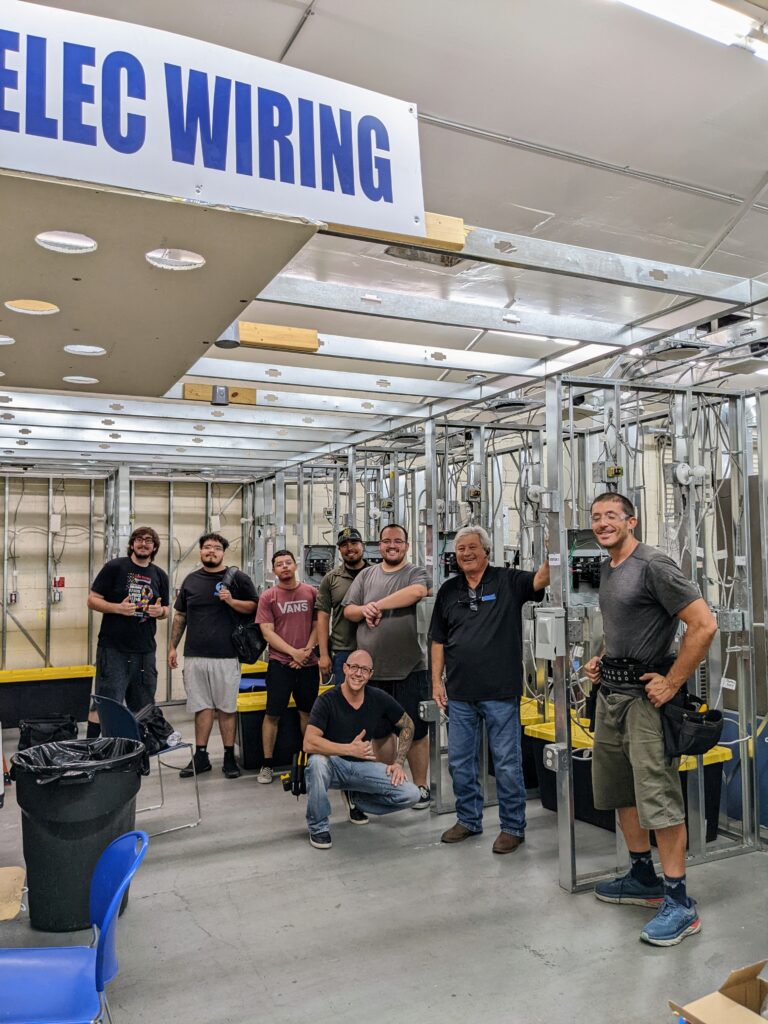
Electrician Trade School In Las Vegas

QTC's Electrical Technician Program

Get Course Info:

START YOUR ELECTRICIAN CAREER TODAY!

Are you searching for an electrician trade school in Las Vegas, Nevada? Good news: Your search is officially over; Quality Training Centers is for you. We offer a comprehensive program that covers the basic principles of AC and DC theory with residential and commercial wiring—and that’s just the beginning!

Our electrician training emphasizes the understanding of electrical systems and covers major system components, testing equipment, and troubleshooting procedures — working with the National Electrical Code and the Ugly’s Electrical Reference from your first weeks. Classes are three hours a day, Monday through Thursday, and everything needed for lab work is provided by the school: you show up, you wire, you test, you troubleshoot.

Is Electrical Actually Your Trade?

Take the free Trade Fit Quiz — 30 questions about how you like to work, instant result. If electrical’s your match, you’ll see exactly why. If it’s not, better to find out in 10 minutes than 3 months in.

Take the QuizFree • No signup to see your result
12 weeksProgram length
144 hours12 courses
Mon–Thu3 hrs/day · 3 time slots
NEC-basedCode-first training
20 maxStudents per class

Why Train at Quality Training Centers

Code-first from day oneYou learn to look things up the way working electricians do — in the NEC and the Ugly’s Electrical Reference — not just memorize answers.
Hands-on labs, materials providedWiring methods, conduit bending, junction boxes, motor controls — all practiced in the lab, with everything you need supplied by the school.
Small classes, real attentionClasses cap at 20 students. Instructors see your work and correct your habits before they become bad ones.
Three schedules that fit a jobMorning, afternoon, and evening slots, 3 hours a day, Monday–Thursday — built for people who work while they train.
Residential and commercialFrom branch circuits and lighting in homes to transformers, motor controls, and service distribution in commercial settings.
A Las Vegas institution since 1994QTC has trained technicians in this city for 32 years, with graduates who have gone on to work at major resorts, hospitals, and service companies across the valley.
Your tool kit is includedTuition covers books and a professional tool kit that’s yours to keep — you graduate with your own tools, not a shopping list.
New classes every six weeksNo waiting for a fall semester. Morning, afternoon, and evening cohorts start about every six weeks, year-round.

How We’re Different From Traditional Schools

QTC was built around a single question: what would a trade school look like if the contractor hiring the graduate was the customer — not the student? That answer is this school, and it changes everything below it. Most schools optimize for enrollment; we optimize for what happens after graduation.

Traditional SchoolQuality Training Centers
Primary goalEnrollment numbersPlacement & retention
The productThe educationThe hire-ready technician
The customerThe studentThe contractor
Quality metricGraduation rateDay-one billable performance
CurriculumTextbook theoryContractor-driven

ELECTRICAL TECHNICIAN TRAINING

Our Available Courses

We provide twelve different courses over a 12-week period of time, totaling 144 hours. Our Electrical Technology courses include the following, in sequence:

E101 — Electrical Theory and Safety

How electricity behaves — voltage, current, resistance, and how resistance affects a circuit — plus the safety practices that come before any live work: lockout/tagout thinking, PPE, and safe meter use.

E102 — Electrical Tools

The working electrician’s toolbag: strippers, benders, fish tapes, meters, and testers — what each is for and how to use it without damaging conductors or yourself.

E103 — Drawings & Schematics

Reading and analyzing electrical drawings, one-line diagrams, and schematics, so a set of prints tells you what a building’s electrical system is doing.

E104 — Wiring Methods

Residential and commercial wiring practices: cable types, routing, securing and supporting, and the NEC articles that govern each method.

E105 — Conduit and Junction Boxes

Bending and installing conduit, sizing and filling junction boxes, and making terminations that pass inspection.

E106 — Overcurrent Protection & Service Distribution

Breakers, fuses, panels, and services: how power gets from the utility to every circuit in a building, and how it’s protected along the way.

E107 — Transformers and Grounding

Transformer principles and connections, plus grounding and bonding — the part of the Code that exists to keep faults from becoming fires or injuries.

E108 — Branch Feeders and Lighting

Branch circuits, feeders, and lighting systems: load calculations in practice, switching arrangements, and lighting circuits from panel to fixture.

E109 — Motors

Single-phase and three-phase motors: nameplates, connections, rotation, and the tests that tell you whether a motor is worth saving.

E110 — Motor Controls

Starters, contactors, overloads, and control circuits — the ladder-logic thinking behind every pump, fan, and machine in commercial buildings.

E111 — Maintenance Troubleshooting

Systematic electrical troubleshooting on the kinds of faults maintenance electricians see daily, using meters and prints together.

E112 — Troubleshooting and Final Labs

The capstone: bugged circuits and systems you diagnose and repair under time, pulling together theory, code, and bench skills.

Throughout these courses, you’ll learn imperative information, such as how resistance affects an electrical circuit, how to safely work with electrical wirings and circuit breakers, how to read and analyze electrical drawings, how to utilize the National Electrical Code and the Ugly’s Electrical Reference book, and so much more!

All of our classes are three hours a day, Monday through Thursday. Additionally, everything needed for school involving lab work is provided by the school. Schedule a school tour today to learn more about QTC’s electrical technician program.

What You’ll Practice in the Lab

The 144 hours split between instruction and bench work. By the end of the program you will have personally practiced: wiring receptacle, switch, and lighting circuits to code; bending EMT conduit and making clean, secure runs into junction boxes; landing conductors in panels and terminating to breakers; testing circuits with a multimeter and interpreting what the readings mean; reading one-line diagrams and building the circuit they describe; connecting and reversing single- and three-phase motors; wiring motor-control circuits with starters, contactors, and overloads; and troubleshooting bugged circuits an instructor sabotaged until you can find faults on the clock. All materials and lab equipment are provided by the school.

Who This Program Is For

The program fits recent graduates who want a trade instead of a lecture hall; career changers who want work that can’t be outsourced; veterans using VA education benefits; and working adults — the 3-hour class blocks exist specifically so you can train around a job. If you’re methodical, safety-minded, and want a foundation in how the electrical trade actually works in Nevada, this is the on-ramp.

ELECTRICIAN PROGRAM SCHEDULE

Electrical Technician Certification

Next start dates:

Sep 7 · AfternoonSep 21 · EveningOct 5 · MorningOct 19 · AfternoonNov 2 · EveningNov 16 · Morning

Morning, Afternoon, and Evening Classes Available – Choose from various time slots to fit your schedule. All classes are 3 hours a day, Monday – Thursday

Note: Schedule adjustments may occur. Please call to confirm.

* Class has a 2 week  winter break: 12/21/26 to 01/03/27

TUITION & FEES

$8,900  all-in — one price, no surprise fees, ever

Tuition for cohorts starting in 2026.

That one number covers your tuition, registration fee, books, lab materials, and a professional tool kit that’s yours to keep. Some Las Vegas programs list $16,500 or more in tuition alone — before tools, exam fees, or materials — and take 9 or 10 months to finish. We’ll train you in 12 weeks for a fraction of that, and you walk out with your tools.

Ways to pay: monthly and weekly payment plans, workforce funding for those who qualify, and VA education benefits for veterans and eligible military personnel — plus $400 off when you pay tuition in full. We do not accept FAFSA. Full details on our Student Financing page.

ADMISSION REQUIREMENTS

  • High School diploma or equivalent (GED), or
  • Pass a simple mechanical aptitude test for those beyond compulsory school age

Ready to register for electrician trade school in Las Vegas, Nevada? Contact us today by calling 702-597-0861. Quality Training Centers is ready to help take your career to the next level.

Prefer to learn the theory at home? This program is also available through QTC FLEX, our hybrid format — classroom online at your own pace, hands-on in our labs. The schedule flexes. The standard doesn’t.

Your Path in the Electrical Trade in Nevada

Starting out — electrical technicians and trainees in Nevada work under licensed electrical contractors. A hands-on, code-based program prepares you to apply for entry-level technician and trainee positions.

Journeyman status — in Southern Nevada, journeyman electrician cards are issued at the county level after documented on-the-job experience and an exam. Your classroom hours and NEC foundation are the running start.

Contractor license — running your own electrical business requires a C-2 electrical contractor license from the Nevada State Contractors Board, after years of documented experience.

Where Electrical Skills Are Used in Las Vegas

The valley’s resorts, hospitals, warehouses, and housing all depend on electricians and electrical maintenance technicians. The skills taught in this program are the ones used in residential wiring and service, commercial maintenance, low-voltage and lighting work, and motor and control work in plants and facilities.

In the Las Vegas metro itself, electricians out-earn the country: the local median is $70,890 a year — about $7,700 above the national median — with the lowest-paid ten percent around $45,810 and the top ten percent above $121,200 (U.S. Bureau of Labor Statistics, Occupational Employment and Wage Statistics, May 2025, Las Vegas–Henderson–North Las Vegas, NV metro area). Nevada’s own Department of Employment, Training & Rehabilitation projects 16.9% growth for electricians statewide from 2024 to 2034 — nearly a thousand job openings a year.

Nationally, the U.S. Bureau of Labor Statistics reports a median wage of $63,190 per year (May 2025) for electricians, with employment projected to grow 9% from 2025 to 2035 — much faster than the average for all occupations. Individual pay varies by employer, role, and experience.

Meet Two of Our Electrical Instructors

QTC’s programs are taught by a deep bench of working contractors and trade veterans — here are two of the instructors leading our electrical labs:

Kevin Kennard, Electrical Instructor at Quality Training CentersKevin Kennard

Electrical Instructor
30 years experience · 5 licenses & certs
NV Master ElectricianNV JourneymanCA Electrical ContractorICC Commercial InspectorICC Residential Inspector

“If you need something, ask me. We will do it together.”

How to Enroll

1. Tour the schoolSee the wiring labs and meet instructors. Book online or call (702) 597-0861.
2. ApplyBring a high school diploma or GED — or, if you’re beyond compulsory school age, pass a simple mechanical aptitude test.
3. Pick your start dateMorning, afternoon, or evening. Cohorts cap at 20, with new classes about every six weeks.

Electrician Program FAQs

How long is the electrician program?

12 weeks — twelve courses totaling 144 hours. Classes run 3 hours a day, Monday through Thursday, with morning (9 am–12 pm), afternoon (1–4 pm), and evening (5:30–8:30 pm) options.

How much does electrician school cost in Las Vegas?

Tuition is $8,900 all-in for cohorts starting in 2026 — and that includes registration, books, and your professional tool kit. No surprise fees. Payment plans, workforce funding, and VA education benefits are available, plus a $400 discount for paying tuition in full. See our Student Financing page.

What will I actually learn?

How resistance affects a circuit, how to work safely with wiring and breakers, how to read electrical drawings, and how to use the National Electrical Code and Ugly’s Electrical Reference — across residential and commercial wiring, conduit, transformers, motors, motor controls, and troubleshooting.

What are the requirements to enroll?

A high school diploma or GED — or, if you’re beyond compulsory school age, passing a simple mechanical aptitude test.

Do I need a license to work as an electrician in Nevada?

Not to start: electrical technicians work under licensed contractors. Journeyman cards come later, at the county level, after documented experience and an exam — and a C-2 contractor license from the State Contractors Board is only needed to run your own company.

When does the next class start?

New cohorts begin about every six weeks in each time slot — see the dates above and call (702) 597-0861 to confirm availability. Classes cap at 20 students.

Do I need my own tools or materials?

No — everything needed for lab work is provided by the school, and your professional tool kit is included in tuition.

Can I work while attending?

Yes — classes are 3-hour blocks with three time slots, designed so you can hold a job while you train.

Is this residential or commercial training?

Both. The first half of the sequence builds residential fundamentals — wiring methods, branch circuits, lighting — and the second half moves into commercial territory: transformers, service distribution, motors, and motor controls.

Can veterans use their benefits here?

Yes — QTC is approved for the training of veterans, and VA education benefits can be applied to the program. Bring your Certificate of Eligibility; our team will walk you through the paperwork.

Is 12 weeks really enough to start in the electrical trade?

Twelve weeks covers what an entry-level electrical technician needs on day one: safety, theory, wiring methods, code navigation, and troubleshooting habits. The trade itself builds skill through experience on the job — the program’s role is to make those first hours productive and safe.

How is this different from an apprenticeship?

An apprenticeship is a multi-year earn-while-you-learn track with classroom hours spread across it. This program front-loads the classroom and lab foundation into 12 weeks, so you can pursue technician and trainee roles — or enter an apprenticeship — already knowing your way around theory, tools, and the NEC. They’re different roads into the same trade.

Wage and employment outlook source: U.S. Bureau of Labor Statistics, Occupational Outlook Handbook, “Electricians” — median annual wage $63,190 (May 2025); projected employment growth 9% from 2025 to 2035. Available at bls.gov/ooh/construction-and-extraction/electricians.htm. Accessed August 2026. Individual earnings vary by employer, role, and experience; statistics describe the occupation nationally and are not a promise of employment or wages.

Come Walk the Wiring Lab Before You Decide

See the labs, meet the instructors, and get every question answered in one visit.