
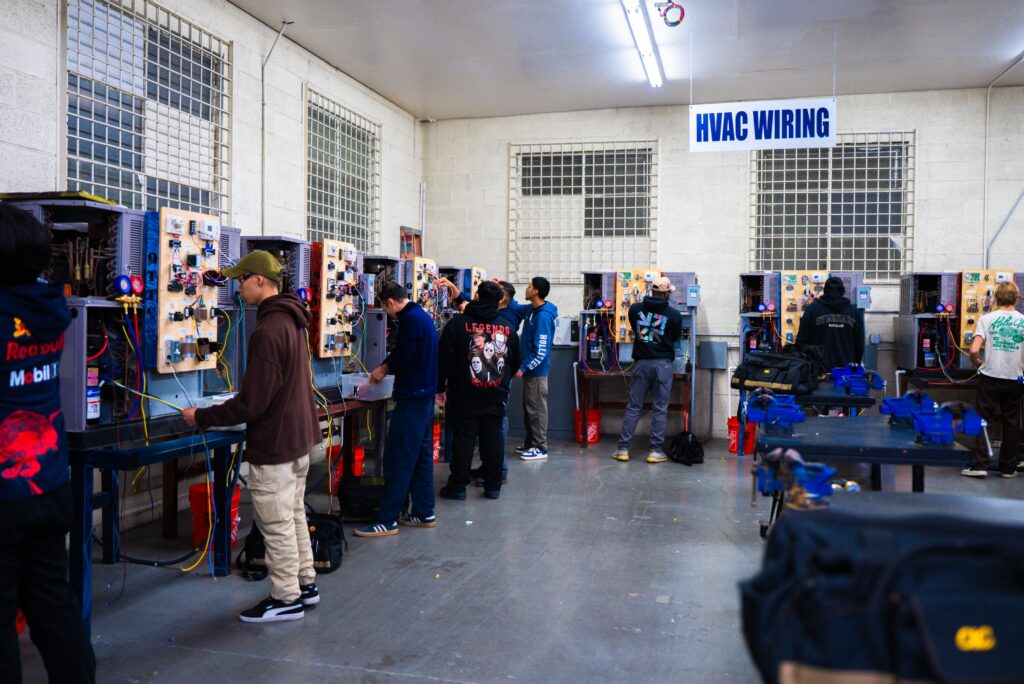
Where HVAC Skills Are Used in Las Vegas
Las Vegas runs on climate control — twelve months a year, at a scale few cities match. The skills taught in this program are the ones used daily in residential service and installation, commercial and resort property maintenance, hospital and school facilities work, and commercial refrigeration for restaurants, groceries, and bars. Typical roles in the field include HVAC service technician, installer, maintenance technician, and commercial refrigeration technician.
In the Las Vegas metro itself, HVAC technicians earn a median of $60,240 a year — the lowest-paid ten percent around $40,760 and the top ten percent above $88,870 (U.S. Bureau of Labor Statistics, Occupational Employment and Wage Statistics, May 2025, Las Vegas–Henderson–North Las Vegas, NV metro area). Nevada’s own Department of Employment, Training & Rehabilitation projects 14.3% growth for HVAC technicians statewide from 2024 to 2034, with roughly 453 job openings a year.
Nationally, the U.S. Bureau of Labor Statistics reports a median wage of $61,010 per year (May 2025) for heating, air conditioning, and refrigeration mechanics and installers, with employment projected to grow 11% from 2025 to 2035 — much faster than the average for all occupations. Individual pay varies by employer, role, and experience.
Meet Two of Our HVAC Instructors
QTC’s programs are taught by a deep bench of working contractors and trade veterans — here are two of the instructors leading our HVAC labs:
 David Wojciechowski
HVAC Instructor
15 years experience · 6 licenses & certs
EPA UniversalC-21b Contractors LicenseTrane Certified SpecialistLennox Factory TrainedMitsubishi Certified410A Certified
“I want my students to know they can be honest, keep their integrity, and still make a great living.”
 Mario Alvarez
HVAC/Refrigeration Instructor
15+ years experience
HVAC/Refrigeration Certified
“It’s never too late to keep learning. Make mistakes — just don’t make the same one twice.”
How to Enroll
1. Tour the schoolWalk the lab, meet instructors, see the equipment you’ll train on. Book online or call (702) 597-0861.
2. ApplyBring a high school diploma or GED — or, if you’re beyond compulsory school age, pass a simple mechanical aptitude test.
3. Pick your start dateMorning, afternoon, or evening. Cohorts are capped at 20, and new classes start about every six weeks.
HVAC Program FAQs
How long is HVAC school at Quality Training Centers?
12 weeks — 192 hours of hands-on training. Classes run 4 hours a day, Monday through Thursday, with morning (8 am–12 pm), afternoon (1–5 pm), and evening (5:30–9:30 pm) time slots.
How much does HVAC school cost in Las Vegas?
Tuition is $8,900 all-in for cohorts starting in 2026 — and that includes registration, books, your EPA 608 exam, and your professional tool kit. No surprise fees. Payment plans, workforce funding, and VA education benefits are available, plus a $400 discount for paying tuition in full. See our Student Financing page.
Is EPA 608 certification included?
Yes. EPA Section 608 certification is required by federal law for anyone working with refrigerants, and it’s built into the program — you study the material with us, then take your proctored exam at our Las Vegas campus.
What do the EPA 608 certification types mean?
EPA 608 comes in Type I (small appliances), Type II (high-pressure systems, like most residential and commercial A/C), Type III (low-pressure chillers), and Universal (all three). The program prepares you for the exam so you can test for the certification level your work requires.
What are the requirements to enroll?
A high school diploma or GED — or, if you’re beyond compulsory school age, passing a simple mechanical aptitude test.
Do I need a license to work as an HVAC technician in Nevada?
Technicians work under licensed contractors, so you don’t need your own contractor license to start working. You do need EPA 608 for refrigerant work — included in the program. A Nevada C-21 contractor license only comes into play if you later open your own company.
How much do HVAC technicians make?
In the Las Vegas metro, the median is $60,240 a year, with the top ten percent above $88,870 (BLS Occupational Employment and Wage Statistics, May 2025). Nationally, the median wage for HVAC mechanics and installers was $61,010 per year in May 2025, and employment is projected to grow 11% from 2025 to 2035 — much faster than average (U.S. Bureau of Labor Statistics; full citation below). Individual pay varies by employer and experience.
When does the next class start?
New cohorts begin about every six weeks in each time slot — see the start dates above, and call (702) 597-0861 to confirm seat availability. Classes are capped at 20 students.
Can I work while going to HVAC school?
Yes — classes are 4-hour blocks with three time slots (morning, afternoon, evening), designed so you can hold a job while you train.
Do I need to buy my own tools?
No. A professional tool kit is included in tuition, and it’s yours to keep after graduation. Books are included too.
What’s the difference between the A/C and refrigeration courses?
The A/C series (101–106) covers residential and light-commercial heating and cooling; the R series (113–116) covers commercial refrigeration — walk-ins, low-temp systems, and ice machines. You complete both in the 12 weeks, which is what lets you work on the commercial equipment Las Vegas runs on.
Can veterans use their benefits here?
Yes — QTC is approved for the training of veterans, and VA education benefits can be applied to the program. Bring your Certificate of Eligibility; our team will walk you through the paperwork.
Is 12 weeks really enough to become an HVAC technician?
Twelve weeks of concentrated, hands-on training covers the fundamentals employers expect from an entry-level technician: the refrigeration cycle, electrical diagnosis, brazing, and commercial refrigeration, plus EPA 608. Like every trade, the rest of your skill is built on the job — the program’s role is to make you useful from your first day, with safe habits and a diagnostic method that experienced techs can build on.
Wage and employment outlook source: U.S. Bureau of Labor Statistics, Occupational Outlook Handbook, “Heating, Air Conditioning, and Refrigeration Mechanics and Installers” — median annual wage $61,010 (May 2025); projected employment growth 11% from 2025 to 2035. Available at bls.gov/ooh. Accessed August 2026. Individual earnings vary by employer, role, and experience; statistics describe the occupation nationally and are not a promise of employment or wages.
Quality Training Centers proudly serves Las Vegas, NV

Supported by poliSCHOOL Student Information System
Copyright © 2026 Quality Training Centers